21 - Linked List Cycle Detection
Given the beginning of a linked list head, return true if there is a cycle in the linked list. Otherwise, return false.
There is a cycle in a linked list if at least one node in the list can be visited again by following the next pointer.
Examples
Example 1
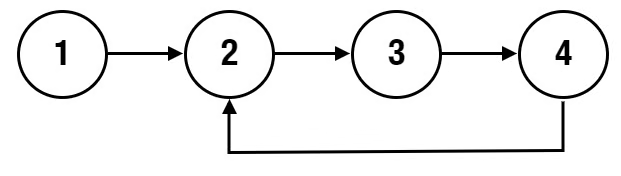
Input:
Output:
Explanation: There is a cycle in the linked list, where the tail connects to the 1st node (0-indexed).
Example 2
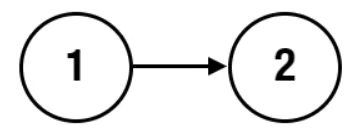
Input:
Output:
Solution
Java Code
/**
 * Definition for singly-linked list.
 * public class ListNode {
 *     int val;
 *     ListNode next;
 *     ListNode() {}
 *     ListNode(int val) { this.val = val; }
 *     ListNode(int val, ListNode next) { this.val = val; this.next = next; }
 * }
 */

class Solution {
    public boolean hasCycle(ListNode head) {
        // Floyd's Cycle-Finding Algorithm (Fast and Slow pointers)
        ListNode slow = head;
        ListNode fast = head;

        while (fast != null && fast.next != null) {
            // Move slow pointer by 1 step
            slow = slow.next;
            // Move fast pointer by 2 steps
            fast = fast.next.next;

            // If they meet, there is a cycle
            if (slow == fast) {
                return true;
            }
        }

        // If fast reaches null, no cycle exists
        return false;
    }
}
Intuition
Cycle detection in a linked list can be solved elegantly using Floyd's Cycle-Finding Algorithm, also known as the "Tortoise and Hare" algorithm.
- Two Pointers: We use a
slowpointer (moves 1 step at a time) and afastpointer (moves 2 steps at a time). - The Chase:
- If there is no cycle, the
fastpointer will eventually reach the end of the list (null). - If there is a cycle, the
fastpointer will eventually "lap" theslowpointer and they will meet at the same node. - Why it works: Inside a cycle, the distance between the fast and slow pointers increases by 1 in each step. Eventually, this distance will equal the length of the cycle, meaning the pointers will coincide.
Complexity Analysis
Time Complexity
In the worst case, the fast pointer traverses the list and the cycle. The number of steps is proportional to the number of nodes.
Space Complexity
We only use two extra pointers (slow and fast), regardless of the list size.
Key Takeaways
- Tortoise and Hare algorithm is the standard \(O(1)\) space solution for cycle detection.
- Fast pointer must move twice as fast as the slow pointer.
- Always check
fast != nullandfast.next != nullto avoidNullPointerException.