11 - Container With Most Water
You are given an integer array heights where heights[i] represents the height of the \(i^{th}\) bar.
You may choose any two bars to form a container. Return the maximum amount of water a container can store.
Examples
Example 1
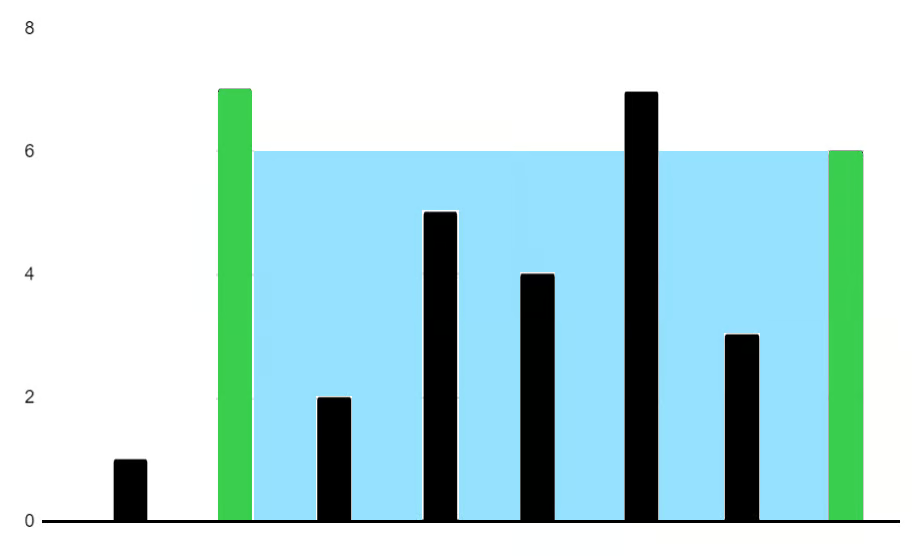
Input:
Output:
Example 2
Input:
Output:
Solution
Java Code
class Solution {
    public int maxArea(int[] heights) {
        int maxArea = 0;
        int left = 0;
        int right = heights.length - 1;

        while (left < right) {
            // Calculate current area
            // Area = width * minHeight
            int width = right - left;
            int minHeight = Math.min(heights[left], heights[right]);
            int currentArea = width * minHeight;

            // Update maximum area
            maxArea = Math.max(maxArea, currentArea);

            // Move the pointer pointing to the shorter bar
            // Logic: Shorter bar limits the height, so we skip it to find a taller one
            if (heights[left] < heights[right]) {
                left++;
            } else {
                right--;
            }
        }

        return maxArea;
    }
}
Java Collections Framework & Utility Components Used
1. Math.min() & Math.max()
What they are
Static utility methods from the java.lang.Math class used to find the minimum and maximum of numerical values.
How they are used
These methods replace traditionalif-else blocks for cleaner, more readable logic when comparing metrics like height and area.
2. Note on JCF
While this specific optimal solution uses primitive arrays for performance, in a real-world JCF-heavy context, heights could be passed as a List<Integer>, which would require using list.get(index) and list.size().
Intuition
The amount of water is determined by the width between two bars and the height of the shorter bar.
Area = (RightIndex - LeftIndex) * min(Height[Left], Height[Right])
- Start wide: Place pointers at the leftmost and rightmost bars. This gives the maximum possible width.
- Move inward wisely: To increase the area, we need a taller bar because the width will only decrease as we move pointers inward.
- The Greedy Choice: Always move the pointer that points to the shorter bar. Moving the taller bar's pointer won't increase the area (it will still be limited by the shorter bar), but moving the shorter bar's pointer gives us a chance to find a taller one that might compensate for the reduced width.
Complexity Analysis
Time Complexity
We traverse the array once using two pointers meeting in the middle.
Space Complexity
We only use a few integer variables (left, right, maxArea, etc.) regardless of input size.
Key Takeaways
- Two-pointer greedy approach reduces the problem from \(O(n^2)\) to \(O(n)\).
- The bottleneck is always the shorter bar.
- Using
Mathutilities keeps the core logic concise.